Where is your team?
A region ranked last, a city I did not know and a kind of sales I had never done. What I did on purpose, and the model that came out of it.
More than ten years ago I was given charge of a team in Hyderabad. The region was ranked last, and I had no experience in that kind of sales. I had managed large teams before, but never in a different culture or a different setting like this one.
Six months later the region was first. Nothing I did in those six months was by accident.
First, get to know them
Before any plan, the job was to know the team. Who they were, how they worked together, what the culture felt like from the inside, where relationships were strong and where they were strained. Rapport came before anything else.
Then listen more than you talk. When you are new, there is a pull to act as if you already know it all. Better not to pretend. Ask a lot of questions, and ask them because you genuinely want to learn. People can tell the difference.
Stakeholders too. Meet them and hear what they think of the team and of the wider organisation.
Then, stand with them
Performance sessions got longer, and the front liners were in the room as well as the managers. That is where encouragement reaches the people actually doing the work.
And defend them. A team that has been last for a while needs to know its leader is on its side.
Only then, ask the question
After a couple of months, the questions started. Can we become the number one team? Why are we last? What is holding us back?
Then, what will it take for us to lift our performance? And what support do you need from me?
We took inspiration from the winning teams. We set smaller milestones and achieved them. At last, when they were ready, the commitment came. From top to bottom, with no turning back.
The model behind it
I have used the same model since, to build and manage large teams. Learn, define, build and execute.
Learn. Know the culture of the team, its strengths and the areas to watch.
Define. Who we are and what we want to achieve as a team. Nothing moves to Build until this is clear.
Build. What it will take to deliver. Tools, systems and commitment.
Execute. Deliver, with no turning back.
Where is your team?
Once you have the model, you can see where your team stands.
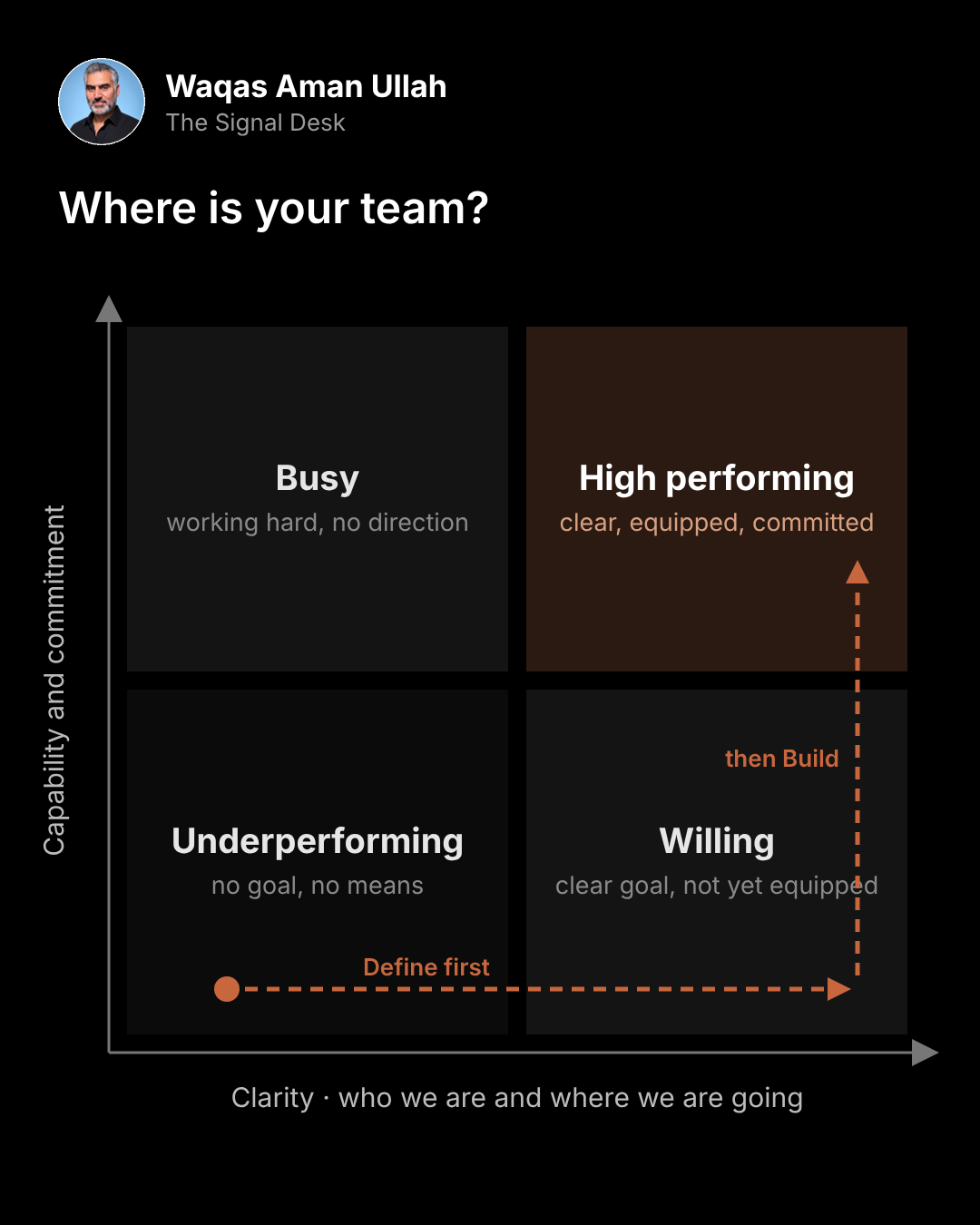
An underperforming team has no clear goal and no means to reach it. A willing team knows where it is going but is not yet equipped. A busy team works hard with no direction. A high performing team is clear, equipped and committed.
The way out goes right first, then up. Define, then build.
If you look at your own team today, which box is it in?