Never let a crisis go to waste
Around FY23, Pakistan's cement industry was selling fewer bags, paying twice as much to make each one, and leaving more than half its plants idle. Three years later its margins were higher than before. This is how the model bent without breaking.
Lately I've been studying the business models of Pakistani industries, how they change over time, and how they perform during difficult times. Purely to learn.
This is the first one I have written up properly.
The crisis
Around FY23, one industry was in full crisis.
- Home sales fell from 48.1 million tonnes in FY21 to 38.2 million by FY24, the lowest in seven years.
- The fuel and power bill for each tonne made rose about 140% in two years.
- The State Bank's policy rate hit 22% in June 2023.
- More than half the industry's capacity sat idle. In FY24, plants ran at 47% of what they could make.
Yes, it's cement.
How a bag of cement makes money
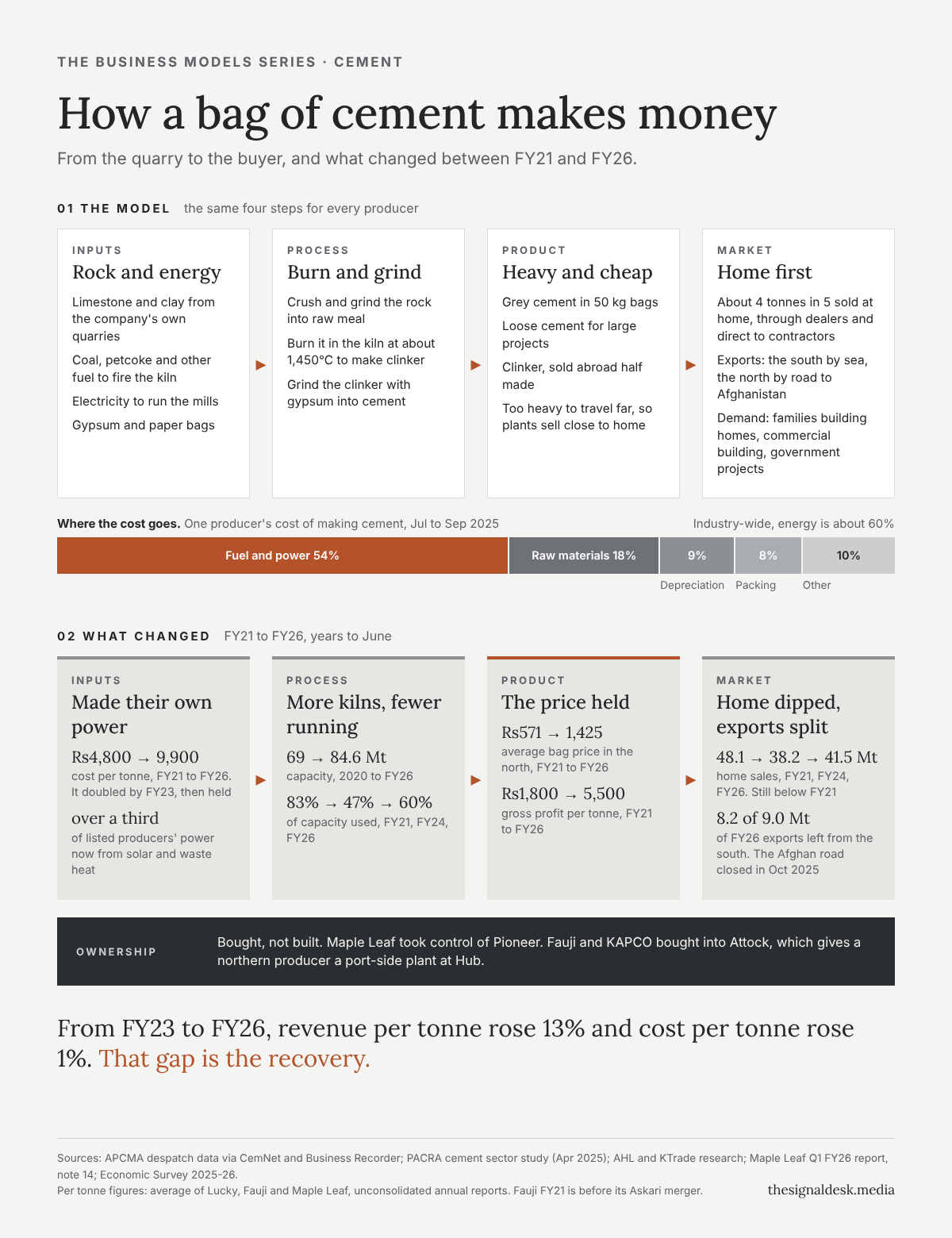
The model is simpler than most. Dig limestone and clay out of your own quarry, burn it in a kiln to make clinker, grind the clinker with gypsum, and put it in a 50 kg bag. About four tonnes in five are sold at home, through dealers for the bag trade and directly to contractors. The rest goes abroad.
That leaves four things that decide whether the business makes money: what energy costs, how full the plants run, where you can sell, and what the market will pay.
Energy is the big one. Across the industry, fuel and power are about 60% of the cost of making cement. Demand comes from government projects, commercial building and families building homes. Almost all of that is decided outside the company.
Cement is also heavy and cheap for its weight, so plants sell close to home. That matters more than it sounds. Three quarters of the country's capacity is in the north, while the port is in the south.
What one tonne earned
I went to the annual reports of Lucky, Fauji and Maple Leaf and worked everything out per tonne sold.
| Per tonne, three companies combined | FY21 | FY23 | FY26 | |---|---|---|---| | Cost | Rs4,830 | Rs9,805 | Rs9,921 | | of which fuel and power | Rs2,864 | Rs6,838 | Rs5,958 | | Gross profit | Rs1,773 | Rs3,929 | Rs5,540 | | Gross margin | 26.9% | 28.6% | 35.8% |
From FY21 to FY23, cost per tonne rose 103% and revenue per tonne rose 108%. Inflation averaged 29% in FY23 and everyone's costs went up together, so the price rises stuck. The margin was protected, not grown.
From FY23 to FY26, revenue per tonne rose 13% while cost per tonne rose 1%.
That gap is the recovery.
What they did
They went after energy. Energy is the cost that swings, so it decides who survives a bad year. Producers built their own power from solar, waste heat recovery and wind, and moved to local and alternative fuels. Solar and waste heat now cover more than a third of the listed producers' power needs. Fuel and power per tonne for the three companies fell 13% between FY23 and FY26.
They looked outward. Exports doubled, from 4.6 million tonnes in FY23 to 9.0 million in FY26, going from a tenth of sales to nearly a fifth. Almost all of it, 91%, left from the south by sea. The north's only export route was the road to Afghanistan.
They consolidated. Maple Leaf took control of Pioneer. Fauji and KAPCO bought into Attock, whose plant sits at Hub, near the sea. That gives a northern producer a port-side plant in the south. Location and scale became things you buy rather than build.
What the numbers do not say
It isn't finished, and I don't want to make it sound neater than it is.
Home sales of 41.5 million tonnes in FY26 are still below FY21. The recovery is in margin, not volume. Plants ran at about 60% last year, against 83% in FY21.
Exports are slipping again. The Afghan border closed in October 2025, and northern exports have been zero in several months since. Total exports fell 11% in July to September 2026.
The three companies I studied did better than the sector. Across a wider group of listed producers, the average gross margin dipped slightly from FY25 to FY26.
The savings came from the factory, not the office. Between FY23 and FY26, distribution cost held steady at about 5% of sales, but people costs grew 58% while sales grew 33%.
And prices held while much of the industry sat idle, which is not what a textbook market does. For the record: the Competition Commission fined 20 producers in 2009 for coordinating prices and despatches, a case still before the tribunal in 2025. It raided the industry association in 2020 on a suspicion of joint price rises, and I found no finding from that. I am stating those facts, not drawing a conclusion from them.
Coal, the rupee, interest rates and government spending will always set the weather for this industry. What changed is how ready it is for it.
My read
As a leader, you don't let a crisis go to waste. That is the approach one should have, and some players in this industry showed it.
Which lever would you have pulled first?
The pointer
The research behind this piece is mostly primary. Company annual reports for Lucky, Fauji and Maple Leaf (unconsolidated, filed on PSX), APCMA despatch data as reported the same day by CemNet and Business Recorder, the PACRA Cement Sector Study of April 2025, and State Bank circulars for interest rates. Where I used broker research (AHL, KTrade, BMA), it was only for industry data, never for anything about the shares.