Someone in the room already knew
How do you get a team to change course when what they are doing still looks like it is working?
On Monday I wrote about placement, and ended by admitting we built our channels first and worked out what each one was for afterwards.
Some of the replies were better than the post. One reframed it in a way I wish I had. The question is not where you sell. It is why a customer would choose that channel at all.
So let me finish the thought.
Three things arrived at once. We were in the middle of a transition. The regulator brought in a new policy on how customers could be signed up. And our own strategy had moved toward higher value customers rather than more of them.
Together they meant how we sold had to change.
The analysis was not the hard part. This was. How do you get a team to change course when what they are doing still looks like it is working?
That room had been measuring acquisition volume for a decade and delivering against it. The numbers were not wrong. What had changed was the strategy, and when the strategy moves the measure has to move with it.
You are asking people to be judged on something new while the old scoreboard still says they are winning.
So I stopped arguing and drew twenty years of our distribution on one page.
Four phases came out of it, each asking a different question. Can customers reach us. Are they coming. Are they buying the right thing. Is this worth what it costs.
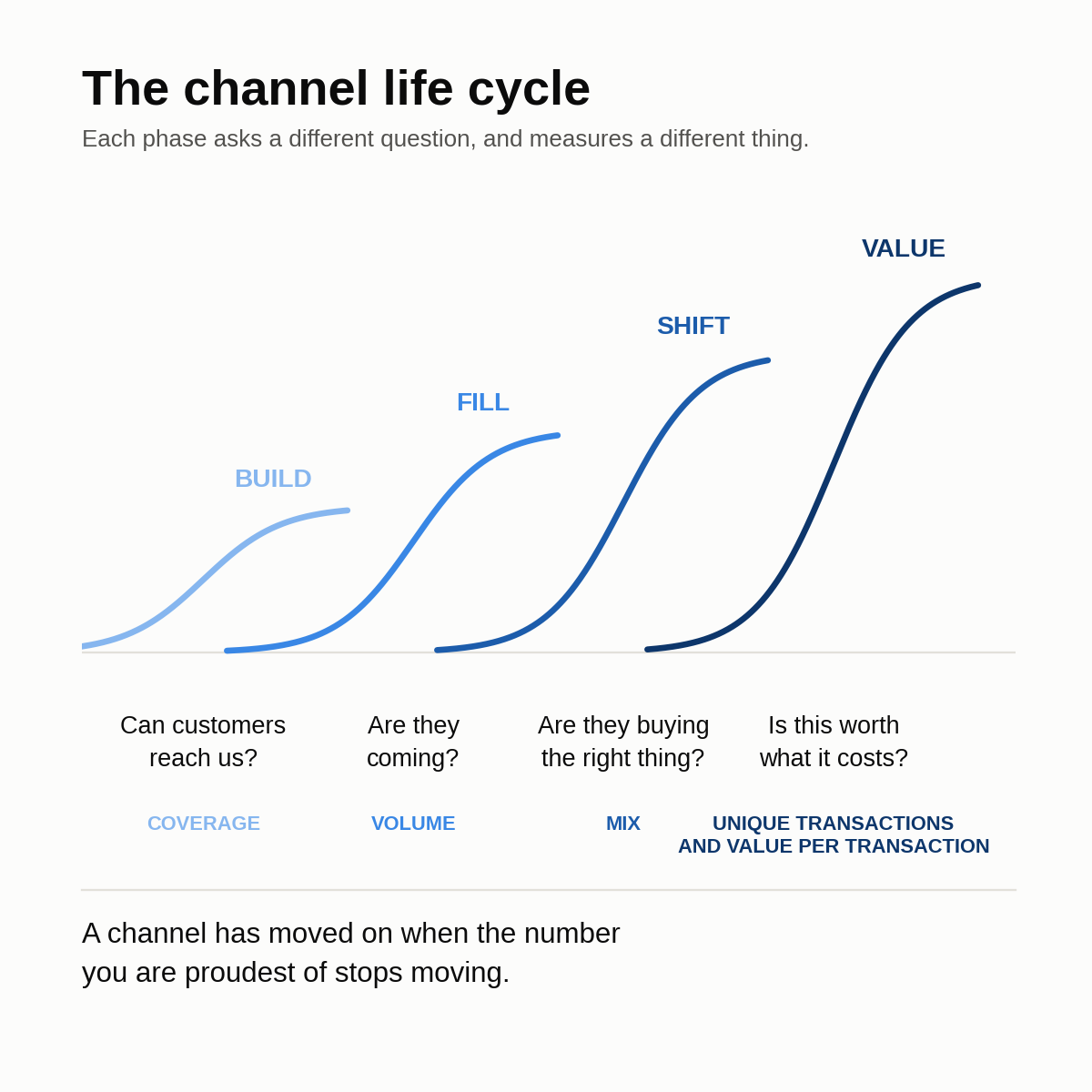
Laid out like that, the argument made itself. We were well into the fourth question and still measuring the second. Drawing it did more than arguing had.
It gave me a signal I have used ever since. A channel has moved on when the number you are proudest of stops moving.
The measure we landed on had nothing to do with volume. Unique transactions, and the value of each one.
None of this was hard to see afterwards. That is the part that bothers me. Someone in that room had noticed each shift long before it reached a slide.
So the question I keep coming back to is not how you spot it. It is how you get an organisation to act on something one person can already see.
The pointer
Aswath Damodaran, The Corporate Life Cycle: Business, Investment, and Management Implications (Portfolio/Penguin, 2024). Publisher listing. His argument is about whole companies rather than channels, and he is far more pessimistic than I am about whether a firm can reinvent its way out of decline. He calls reinvention a siren song. At the level of a whole company I think he is right.